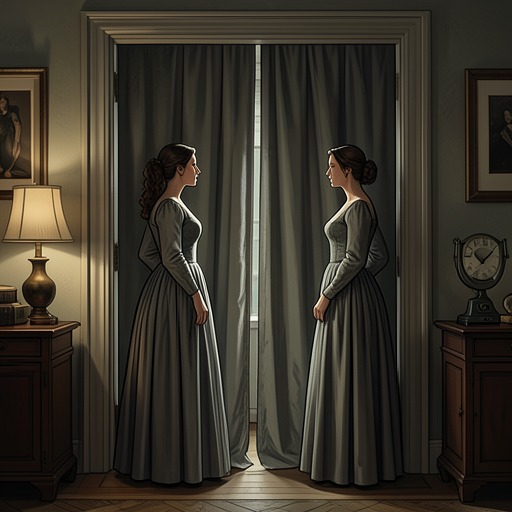
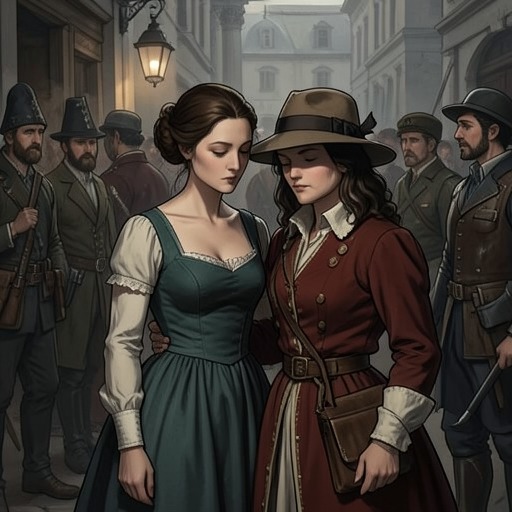
Vivian Regan—Rusty Regan
The Big SleepVivian Regan and Rusty Regan are husband and wife, but their relationship is presented chiefly through Vivian’s attempts to explain his disappearance and protect the family from its consequences. She remembers him as vivid and entertaining, insists that he was not a criminal, and points to his reported departure with Mona Mars as a possible explanation. The truth is more painful: Rusty was murdered by Carmen Sternwood, and Vivian concealed the crime because she feared what the revelation would do to her father. Their marriage thus becomes the apparent center of a missing-person case and, ultimately, the cover story around a hidden death.
Marriage and Family Context
Vivian identifies Rusty as her husband when Philip Marlowe first hears about him. He was the last of her three husbands, an ex-bootlegger who had used the name Rusty Regan in that trade. The family description places the marriage within the Sternwoods’ turbulent private life, but does not establish that Rusty’s criminal past continued into the period of his disappearance.
Rusty mattered to more than Vivian. She tells Marlowe that her father liked him, describing him as earthy and sometimes vulgar but real and fun to be around. In her account, Rusty’s presence brought pleasure to an old, seriously ill man who otherwise lived in decline. His sudden departure therefore represents not only the loss of a husband but also the disappearance of a source of companionship for the General.
Vivian’s Account of Rusty’s Disappearance
Vivian insists that Rusty was not a crook who would have joined a cheap blackmail scheme. She says he had carried fifteen thousand dollars in cash before she married him and still had that money when he left. She calls it his mad money, a detail that makes the departure sound prepared for, while also using his resources and character to distinguish him from the petty criminals involved in the surrounding case.
She offers Marlowe a more dramatic possible explanation: Rusty ran away with Mona Mars, the blonde wife of Eddie Mars. Vivian says she knows Eddie well enough to borrow money from him and presents Mona’s supposed connection to Rusty as a reason Eddie might be willing to help her. The claim gives Rusty’s absence the shape of a marital betrayal and a flight with another woman. Marlowe later reasons that Vivian’s account, and the police’s acceptance of the disappearance as a possible elopement, helped divert attention from what had actually happened.
The story also leaves Vivian’s feelings about the marriage unsettled. She defends Rusty’s character and remembers him as enjoyable company for her father, but the evidence does not show that she loved him. When the truth finally emerges, she says that Rusty was all right but did not mean as much to her, alive or dead, as protecting her father from the knowledge of his murder. Her defense of him is therefore distinct from a declaration of romantic devotion.
The Hidden Truth and Vivian’s Choice
Marlowe eventually identifies the supposed flight with Mona as a constructed explanation. He tells Vivian that Eddie Mars hid Mona at Realito and had Lash Canino guard her, while Rusty’s abandoned car was placed at the garage where Mona had been living. This arrangement made it appear that Mona had run away with Rusty and supplied a misleading account of the disappearance. Marlowe’s reconstruction further connects the deception to Eddie’s effort to keep the police from discovering where Rusty had gone and why.
The decisive truth is that Carmen killed Rusty. Marlowe recalls the afternoon Rusty disappeared: he had taken Carmen to old wells to teach her to shoot, set up a can as a target, and stood nearby while she fired. Carmen did not shoot at the can; she turned the gun on Rusty. Marlowe recognizes the act as the same pattern as Carmen’s later attempt to shoot him. The apparent flight with Mona therefore collapses as an explanation: Rusty did not leave Vivian for another woman but was killed by her sister.
Vivian confesses that Rusty’s body is in a sump and that she went to Eddie Mars after Carmen came home and told her what she had done. Vivian feared that the police would draw the truth out of Carmen, who was not mentally well and might disclose or even boast about the killing. She also believed that the General, if he learned what had happened, would immediately tell the authorities and spend his final hours contemplating his daughter’s crime. Vivian says her motive was to prevent that suffering, not to preserve her marriage or conceal Rusty’s character.
Consequences and Narrative Significance
Vivian’s concealment turns her defense of Rusty into part of a larger pattern of silence. She allowed others to believe he had disappeared with Mona, while Eddie’s arrangements and the false car trail reinforced that account. Marlowe, too, had withheld information during the earlier investigation, and his final exchange with Vivian exposes how the supposed search for a missing husband had been shaped by competing forms of protection, manipulation, and omission.
The marriage remains a relationship narrated through absence: Rusty is remembered by Vivian and the General, represented by the story of his departure, and finally identified through the fact of his death. Vivian’s account initially makes him seem like an active deserter who chose another woman; the revelation reverses that impression and shows that his absence was imposed by violence and then maintained by a family member’s fear for her father. Marlowe’s closing reflection on Rusty’s death as a long sleep underscores the grim contrast between the public appearance of an unexplained disappearance and the private knowledge of where, and how, the marriage ended.